
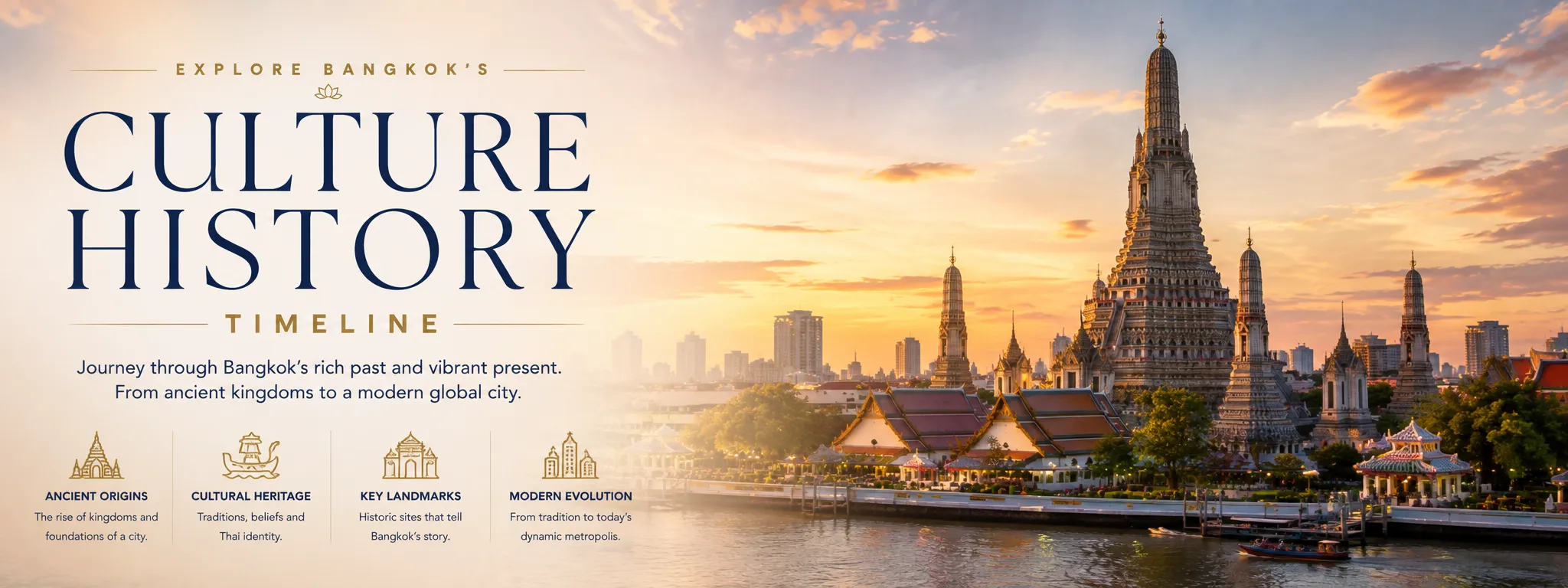
From a small trading post to a capital of over 10 million people.
Bangkok became the capital of Siam in 1782 under King Rama I, who established the royal palace and major temples on the river's east bank.
The 20th century brought rapid modernization, and the BTS Skytrain's opening in 1999 marked a turning point in how the city moved.
Before Bangkok existed, Ayutthaya was the Siamese capital for over 400 years, until it was destroyed by a Burmese army in 1767. King Taksin briefly established a new capital across the river in Thonburi before the Chakri dynasty moved the seat of power to the eastern bank in 1782 — the site that became Bangkok.
King Rama I founded the new capital, named it Rattanakosin, and modelled its layout on Ayutthaya — building the Grand Palace and Wat Phra Kaew as the ceremonial and religious core that still anchors the Old City today.
King Mongkut (Rama IV) opened Siam to Western trade and diplomacy; his son Chulalongkorn (Rama V) abolished slavery, built the country's first railways and roads, and modernised the civil service — reforms credited with keeping Siam the only Southeast Asian nation never colonised by a European power.
A 1932 revolution ended absolute monarchy in favour of constitutional monarchy; the following decades saw rapid urbanisation, the Vietnam War-era US military presence that shaped parts of the city's nightlife infrastructure, and the explosive economic growth of the late 20th century that produced the modern skyline visible today.