
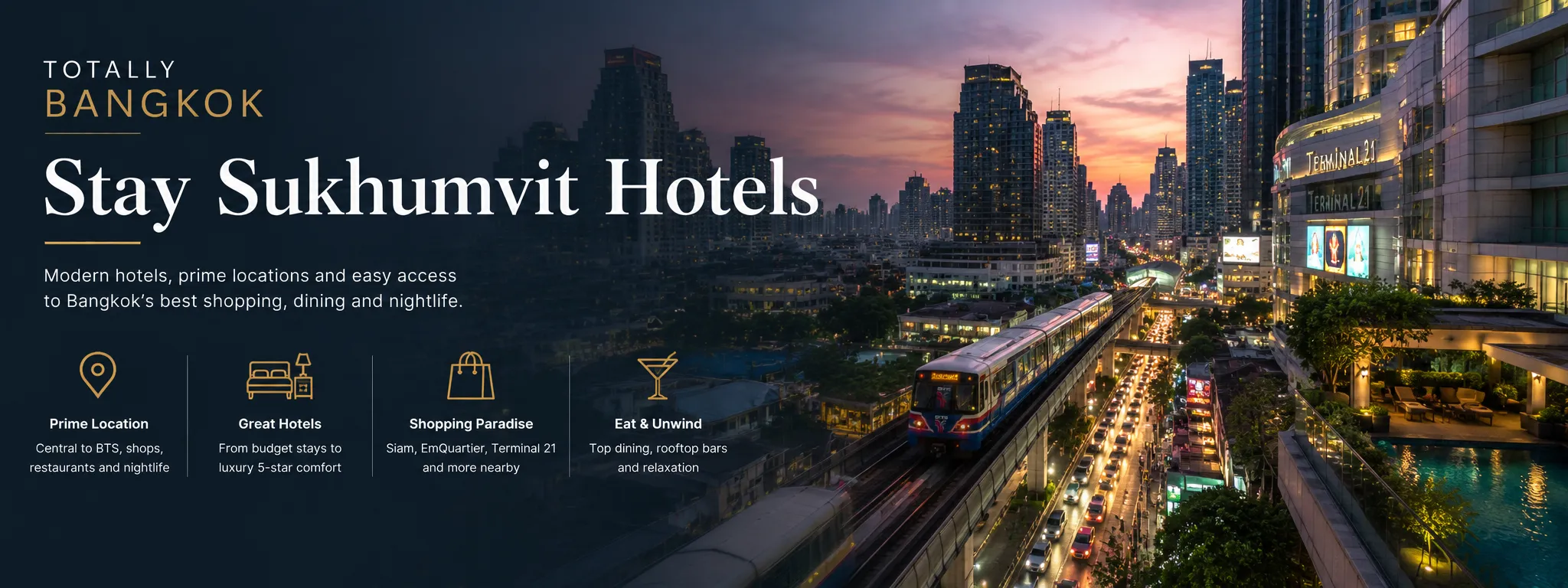
Sukhumvit is not one neighbourhood so much as a long chain of very different hotel zones linked by the BTS Sukhumvit Line. The best choice is usually the hotel that puts you near the station, streets and daily routine you will actually use — not the property with the flashiest lobby or the lowest headline rate.
Sukhumvit is one of Bangkok's easiest bases for travellers who want rail access, late dining, shopping, nightlife and a huge range of accommodation without depending on taxis for every trip. The BTS Sukhumvit Line runs through the main hotel zones at Nana, Asok, Phrom Phong, Thong Lo, Ekkamai, Phra Khanong and On Nut. At Asok, the BTS connects with MRT Sukhumvit, giving you a second rail network for places such as Chinatown, the Old City approaches, Chatuchak and the Queen Sirikit convention area.
The trade-off is that Sukhumvit is long, busy and uneven. A hotel described simply as "Sukhumvit" can be beside a station, ten minutes down a narrow soi, or far enough from the main road that the walk becomes irritating in heat or rain. Treat the nearest station and the actual walking route as part of the hotel specification.
Bangkok's heat, sudden rain and heavy traffic make a short map distance feel longer than it looks on a booking site. A hotel 250 metres from a station with a simple pavement route can be easier than one 500 metres away behind a major junction or deep in a twisting soi. Before booking, map the pedestrian route from the lobby to the correct station entrance, not just the straight-line distance.
If you expect to use rail most days, staying within roughly a comfortable five-to-eight-minute walk of BTS is often worth paying more for. Families with small children, older travellers and anyone who dislikes walking in humidity should be stricter. Some hotels run tuk-tuk or shuttle services to the main road, but these are a convenience rather than a substitute for genuinely good location.
Nana is the most nightlife-heavy part of central Sukhumvit. It suits travellers who want bars, restaurants, convenience stores and activity close to the hotel, and who do not mind a louder streetscape. It is also practical for short stays because the BTS gives quick access east and west without requiring a complicated transfer.
The downside is atmosphere. Some streets around Nana are intensely nightlife-oriented and can feel hectic at night. Families, light sleepers and travellers wanting a calm neighbourhood should inspect the exact soi carefully. A rear-facing room or a hotel a little away from the busiest nightlife lanes can make a large difference.
Asok is the strongest all-round choice for many first-time visitors because BTS Asok and MRT Sukhumvit meet here. BEM's official MRT station information confirms the direct connection between Sukhumvit MRT and Asok BTS. That interchange matters: you can use the BTS for the main Sukhumvit corridor and Siam, then switch to the MRT for many north-south trips without relying on road traffic.
Asok is also busy. The junction is one of the most traffic-heavy parts of central Bangkok, and sidewalks around the interchange can be crowded. Pick Asok if transport flexibility matters more than neighbourhood charm. Hotels a short distance along Soi 18, 20, 21 or 23 can feel calmer while keeping the interchange practical.
Phrom Phong has a more polished residential feel than Nana or Asok, with large malls, Japanese restaurants, cafes and a strong concentration of upper-mid-range and luxury hotels. It is particularly easy for travellers who want shopping and dining close to the hotel without the same nightlife intensity as Nana.
Benchasiri Park sits directly beside Sukhumvit Road near Phrom Phong BTS. Bangkok's official public-space listing identifies Phrom Phong on the Green Line as the park's rail access. That makes the area unusually useful for families, runners or anyone who wants a quick patch of green without leaving the neighbourhood.
Thong Lo is one of Bangkok's strongest dining and nightlife districts, but the experience is different from Nana. The emphasis is more on restaurants, cocktail bars, cafes, clubs and residential towers than on concentrated tourist nightlife. It suits repeat visitors, couples and travellers who plan evenings around food and drinks.
The main caution is distance. Many well-known Thong Lo venues are well north of the BTS station along Sukhumvit Soi 55, so a hotel can be "in Thong Lo" without being convenient for the train. If rail access is important, choose near the southern end of the soi or accept that short taxi or motorcycle-taxi rides may become part of your routine.
Ekkamai is a useful middle ground: still central enough for easy BTS travel, but usually calmer than Asok or Nana. It has restaurants, cafes and nightlife without feeling as saturated with visitors. Travellers continuing to eastern Thailand may also find the area convenient because the Ekkamai bus terminal is nearby, although transport arrangements should always be checked for the specific destination.
For longer stays, Ekkamai can feel more liveable than the most central sections of Sukhumvit. The main road remains busy, but side streets quickly become more residential.
Phra Khanong is often a good choice for travellers who want better room value while remaining directly on the BTS line. It feels more residential and less visitor-focused than Asok or Phrom Phong, with local food, apartment buildings and a growing collection of cafes and small hotels.
The compromise is travel time. You will spend longer on the BTS for Siam, the Old City connections and riverside sightseeing. For a week-long stay, remote work or repeated trips around east Bangkok, that can be a sensible trade. For a two-night sightseeing stop, the saved hotel money may not be worth the extra commuting.
On Nut is one of the most practical budget-conscious bases on the central-to-eastern Sukhumvit corridor. It has supermarkets, casual restaurants, apartments and hotels close to the station, and the BTS keeps central Bangkok straightforward. The area is especially appealing for travellers staying a week or more who value room size, laundry, supermarkets and routine over being in the middle of the nightlife districts.
It is less suitable if most of your plans are around the river, Old City or late-night central Sukhumvit. You can absolutely commute, but repeated journeys add time. Think of On Nut as a good living base rather than the most efficient sightseeing base.
Travellers who like running, walking or green space should consider the southern side of Asok toward Benjakitti Park. Bangkok's official park information lists access from BTS Asok and MRT Sukhumvit or Queen Sirikit National Convention Centre. The large park and forest area changes the feel of a stay: you can be close to one of Bangkok's busiest commercial junctions yet still have a substantial outdoor space within reach.
Hotels on the Asok-to-Queen Sirikit side can therefore work particularly well for business visitors attending events at the convention centre, runners and travellers who want central rail access without spending every free hour inside malls.
Sukhumvit has accommodation at almost every level, but price is only one difference. Budget hotels may be perfectly comfortable yet sit deeper in sois, have smaller rooms, limited soundproofing or no pool. Mid-range properties often offer the best balance of station access, breakfast, pool and room size. Luxury hotels generally add stronger service, better gyms and pools, larger common areas and more polished dining rather than simply a better location.
Avoid treating a star category as a location guarantee. A modest hotel beside BTS may produce a much easier trip than a more impressive property that requires a long walk or daily taxi through congested streets.
Noise varies block by block. Main-road rooms can pick up traffic; nightlife sois can stay active very late; construction can appear beside otherwise excellent hotels. Read recent guest comments specifically for street noise, nightclub bass and building work, and ask for a higher or rear-facing room when that matters.
Quietness also changes within the same soi. A property 150 metres farther from Sukhumvit Road may feel dramatically calmer while still being walkable to BTS. Conversely, a hotel deep in a soi can be quiet but inconvenient. The sweet spot is usually a simple, well-lit walk without being directly above nightlife.
For families, Phrom Phong and the calmer sides of Asok are often easier than Nana. Look for a hotel with a pool, breakfast that works for children, larger room configurations and a straightforward station walk. Benchasiri Park near Phrom Phong gives children outdoor space, while Asok's BTS/MRT interchange reduces the need for repeated taxi rides across town.
Check whether a "family room" is genuinely one room with enough beds or simply two rooms that may not interconnect. Bangkok hotel room definitions vary, so confirm bedding and connection arrangements directly when that is essential.
Solo travellers can make Sukhumvit extremely efficient by choosing near BTS and spending less on hotel extras they will not use. Asok is excellent for transport, Nana for nightlife, Phrom Phong for a more polished environment, and Thong Lo for dining. A staffed reception, good late-night access and a route from the station that feels comfortable are more useful than a huge resort-style lobby.
If you expect to return late, inspect the final few hundred metres between the station and hotel on a map and in recent reviews. Bangkok is generally easy to navigate in these districts, but a dark or awkward soi can still make a cheap booking less appealing.
Asok has the strongest transport advantage for meetings across central Bangkok because of the BTS/MRT interchange. Phrom Phong and Thong Lo are strong for dining and client meetings, while Ekkamai and Phra Khanong can offer larger rooms or serviced-apartment style stays at better value.
Remote workers should check desk ergonomics, Wi-Fi reviews, laundry and whether cafes or coworking spaces are actually within walking distance. For stays of several weeks, supermarket access and a quieter street often matter more than being beside the busiest nightlife.
Sukhumvit is convenient for both Bangkok airports, but road travel times can vary heavily with congestion. A hotel near BTS is useful because you have rail alternatives for parts of the journey and an easier time moving around once checked in. If arriving at a peak traffic time, ask the hotel for realistic transfer options rather than assuming a fixed taxi duration.
For an early flight, convenience to a main road and reliable taxi pickup can be more important than being one minute closer to a BTS entrance. If the flight is extremely early, compare an airport-area hotel for the final night rather than forcing Sukhumvit to solve every part of the itinerary.
Open both properties on a map and compare five things: the walk to BTS, the nearest useful convenience store or supermarket, the character of the soi after dark, likely road access for taxis, and the places you expect to visit most. Then compare recent reviews for noise, housekeeping, air-conditioning and construction. Only after that should you compare pools, breakfasts and room design.
This approach prevents a common mistake: choosing a slightly cheaper hotel that costs time and frustration every day. In Bangkok, transport convenience is part of the room value.
Choose Nana for concentrated nightlife and late hours. Choose Asok for the strongest transport interchange. Choose Phrom Phong for malls, restaurants, Benchasiri Park and a polished central base. Choose Thong Lo for dining and nightlife with a more residential feel. Choose Ekkamai for a calmer central-east base. Choose Phra Khanong for value while staying close to central Bangkok. Choose On Nut for longer stays and practical everyday living.
If you are still unsure, Asok or Phrom Phong are the safest all-round choices for a first visit because they combine rail access with a large range of hotels and services.
For current station information, route changes and fares, use the official BTS SkyTrain website. For the Asok interchange, BEM's official MRT Sukhumvit station page lists the BTS connection. Bangkok Metropolitan Administration provides current information for Benchasiri Park and Benjakitti Park.
Sukhumvit is one of Bangkok's easiest hotel districts, but the right section matters more than the word "Sukhumvit" in the address. For most travellers, station proximity should come first, followed by neighbourhood atmosphere and room quality. Pick Asok for maximum transport flexibility, Phrom Phong for a balanced and polished stay, Nana for nightlife, Thong Lo for dining, and the eastern stations for value and longer stays.
For broader comparisons, see our best areas to stay in Bangkok, budget hostel guide and Sukhumvit area guide.