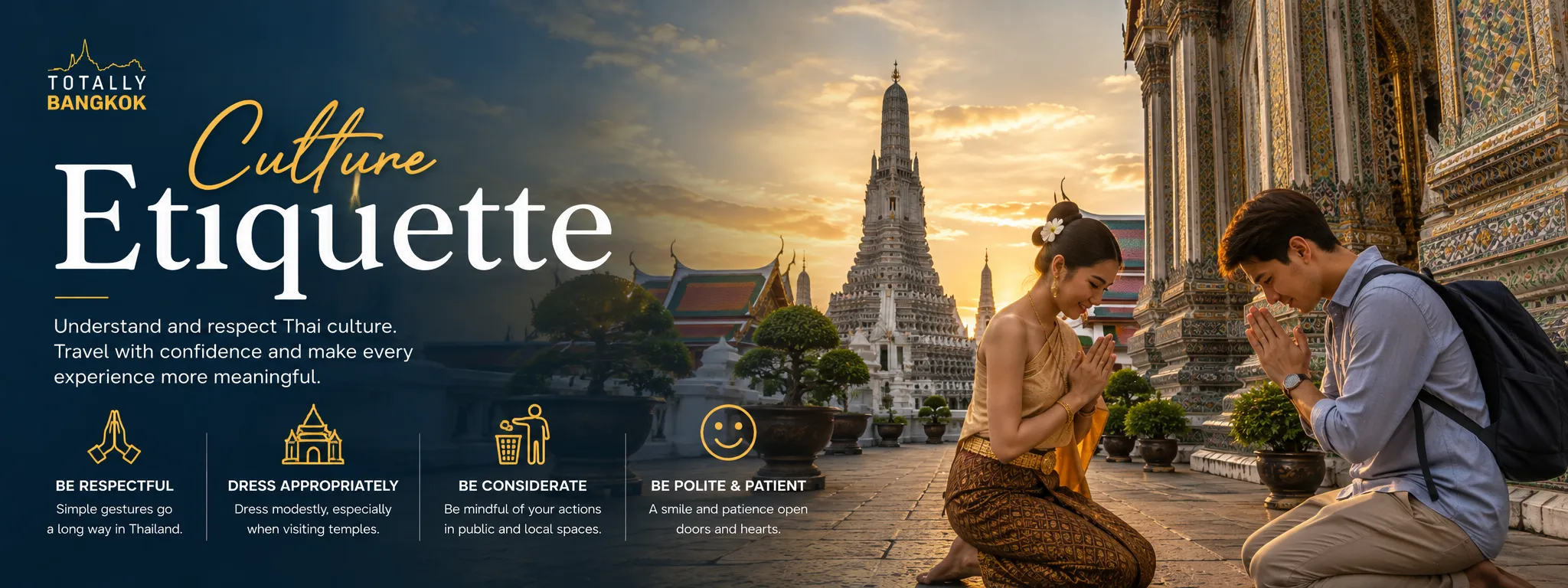
A handful of customs go a long way toward being a respectful visitor.
The traditional greeting — palms pressed together at chest height with a slight bow — is used as both hello and thank you.
Avoid touching anyone's head, pointing your feet at people or Buddha images, and speaking critically of the monarchy.
The prayer-hands wai is Thailand's standard greeting — see the dedicated Wai guide for exactly when and how high to hold it. As a foreigner, you're never expected to initiate one, but returning a wai when offered is always appreciated.
The head is considered the most sacred part of the body and the feet the least — never touch someone's head (even affectionately with children), never point your feet at a person, a Buddha image, or a monk, and be mindful of foot direction when sitting on temple floors.
Shoulders and knees covered, shoes off before entering any building housing a Buddha image, and speak quietly inside — sarongs are usually available to rent or borrow at major temples if your outfit doesn't meet the dress code.
Public displays of anger or raised voices are viewed very negatively — Thai culture strongly values keeping a calm exterior (see kreng jai for the underlying concept), so even a frustrating situation (a taxi dispute, a wrong order) is best handled with a smile rather than visible irritation.