
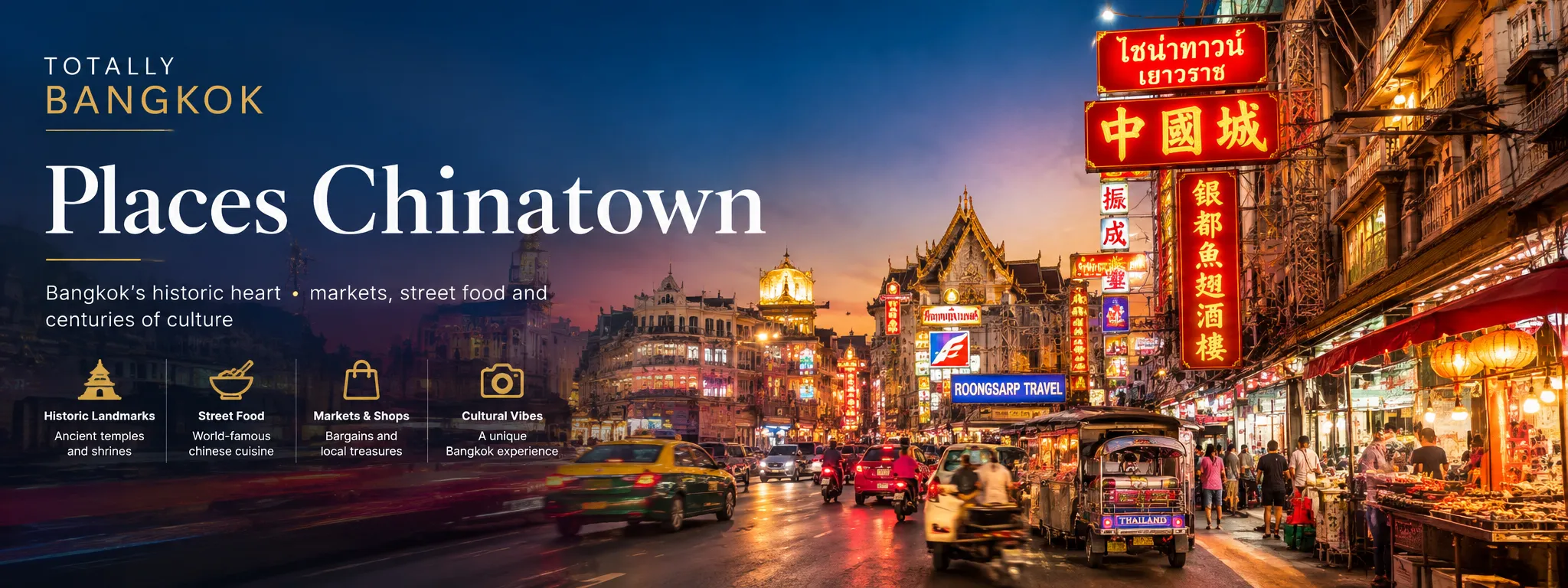
Yaowarat is one of Bangkok's most rewarding districts because daytime commerce, Chinese-Thai heritage and after-dark street food overlap in a compact area served directly by the MRT Blue Line.
Most visitors first hear about Yaowarat as a street-food destination, but the district is much richer than a single evening meal. By day, gold shops, wholesale lanes, traditional medicine businesses, shrines and markets dominate. As evening arrives, the visual character changes: neon signs become more prominent and food vendors take over parts of the main road and surrounding lanes.
The best visit therefore combines both versions. Arrive in the afternoon for temples and backstreets, stay through dusk, then eat after dark.
The MRT Blue Line extension runs directly through the Chinatown area and passes Wat Mangkon Kamalawat. Wat Mangkon station is the most useful arrival point for most visitors because it places you inside the district rather than requiring a long walk from Hua Lamphong. The official MRTA Blue Line alignment confirms the route from Hua Lamphong through the Wat Mangkon area before continuing toward Sam Yot and Sanam Chai.
Hua Lamphong remains useful for the south-eastern edge, while Sam Yot can work if you are combining Chinatown with the Old City. For a simple first visit, Wat Mangkon is the obvious default.
Yaowarat Road is the famous neon-lit artery, but spending the entire visit on that road misses much of what makes Chinatown interesting. The surrounding grid includes Charoen Krung Road, Sampeng's narrow wholesale lanes, Talat Noi toward the river, temples and shrines, small markets and long-established trading streets.
Use Yaowarat as an orientation line, then keep turning into side streets. The neighbourhood rewards slow walking far more than a taxi-window tour.
Wat Mangkon Kamalawat is one of the district's major Chinese Buddhist temples and a useful cultural anchor before the food crowds build. Dress and behave as you would at any active religious site: shoulders and knees reasonably covered, voices low, and photography only where appropriate. Festivals and Chinese religious dates can make the surrounding streets much busier than normal.
The district also contains smaller shrines and religious institutions that are easy to miss if you only follow restaurant queues.
Near the Chinatown Gate and Hua Lamphong side of the district, Wat Traimit is known for its large gold Buddha image and makes a logical cultural stop at the beginning or end of a walking route. It also helps connect Chinatown geographically with the old railway-station area.
If you are temple-fatigued after the Grand Palace and Wat Pho, do not force every religious stop into one day. Chinatown works perfectly well as a market, food and street-life visit.
Sampeng is a dense commercial lane where small goods, fabrics, accessories and household products move through a space that can feel almost impossibly narrow when busy. It is most interesting as a glimpse of working wholesale Bangkok, not as a polished tourist market.
Walk slowly, keep bags close to your body and do not block shopfronts while taking photos. In crowded sections, the main challenge is simply moving with the flow.
South of the main Yaowarat strip, Talat Noi offers a different texture: old shophouses, vehicle workshops, street art, cafés and river-adjacent lanes. It is a good counterpoint to the intensity of central Chinatown and works especially well in daylight when you can see architectural details.
Combine it with the river or nearby Charoen Krung rather than treating it as a completely separate district. Our Talat Noi guide goes deeper.
Tourism Authority of Thailand material describes Yaowarat as a district whose street-food energy becomes especially vivid after business hours. Exact stall days and opening times vary, and individual vendors can move or take days off, so do not build a rigid meal plan around one social-media clip.
Arriving around late afternoon gives you time to orient yourself before the busiest dinner period. If you dislike crowds, eat earlier and use the later evening for walking rather than queueing.
Yaowarat is strong for noodles, seafood, grilled dishes, Chinese-Thai sweets, dim sum, roast meats and long-established shop-house specialities. The most satisfying strategy is to share several small dishes rather than commit to one giant dinner immediately. Follow turnover: a busy stall serving a short menu is often easier to judge than a place trying to sell everything.
Do not assume the longest queue is automatically the best meal. Famous stalls can be excellent, but Chinatown has too many options to spend an hour waiting if you are hungry and flexible.
Daytime is better for markets, gold shops, temples, wholesale lanes, Talat Noi and photography of old commercial streets. Night is better for neon, food stalls and the high-energy Yaowarat atmosphere. If you can spare three or four hours, cross the transition between the two.
For families or travellers sensitive to crowds, an afternoon visit with an early dinner is often more comfortable than arriving at peak evening density.
Begin at MRT Wat Mangkon. Visit Wat Mangkon Kamalawat, then work through the market lanes toward Yaowarat Road. Continue west or south depending on your interests: Sampeng for wholesale shopping, Wat Traimit for a major temple, or Talat Noi for quieter lanes and cafés. Return to Yaowarat as dusk approaches and finish with dinner.
This route avoids unnecessary backtracking and gives you both the working-day and evening versions of the neighbourhood.
Chinatown pairs naturally with Wat Pho, the Grand Palace or Pak Khlong Talat because the MRT Blue Line continues through Sam Yot and Sanam Chai. The temptation is to overfill the day. A Grand Palace morning plus Chinatown afternoon/evening is already substantial, particularly in hot weather.
If temples are your priority, keep Chinatown mostly for food and a short walk. If food and street life are your priority, give Yaowarat the whole second half of the day.
The Chao Phraya remains another useful way to understand Chinatown's commercial geography. Tourism Authority of Thailand river-route material highlights Ratchawong Pier as an access point for Yaowarat and the surrounding trading district. Boat services can change by route and time, so check the current operator schedule before relying on a specific boat for a timed connection.
Chinatown is best explored on foot, which means Bangkok weather matters. Midday heat can make the narrow streets tiring, while sudden rain can flood kerbs and compress crowds under awnings. Wear shoes you are happy to walk in and carry water. An afternoon start often makes more sense than a midday arrival.
Footpaths are uneven in places and frequently busy with stalls, deliveries and parked vehicles. Travellers with mobility needs should allow extra time and use the MRT to minimise long road approaches.
Yaowarat is heavily visited, but normal big-city awareness still applies. Keep phones and wallets secure in dense lanes, pause away from traffic before checking maps, and be careful crossing the main road. The bigger practical risks are traffic, heat and distraction rather than anything uniquely “Chinatown”.
Food-wise, choose busy vendors, look for active cooking and sensible ingredient handling, and be cautious if you have serious allergies because cross-contact can be difficult to control at compact stalls.
Staying in Chinatown suits travellers who prioritise food, heritage and access to the Old City over Sukhumvit nightlife and shopping malls. The MRT has made the district much easier as a base than it once was. It is less convenient if most of your evenings are in Thong Lo, Ekkamai or lower Sukhumvit.
For a first Bangkok visit, compare Yaowarat with Asok/Sukhumvit and Silom before choosing. The right base depends on where you expect to spend your evenings.
Allow at least three hours if you want temples, lanes and food; four or five is better for a relaxed first visit. Arrive via MRT Wat Mangkon, explore side streets before dusk, then eat along and around Yaowarat. For current rail information, use the official MRTA Blue Line. Tourism Authority of Thailand also has a useful Chinatown overview.