
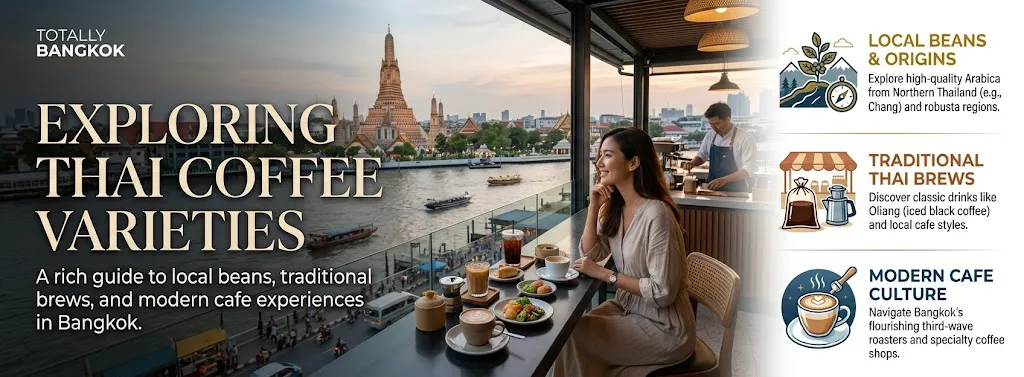
Thailand grows significant quantities of coffee — the regional varieties, what makes Thai coffee distinctive, and the blends in your iced coffee.
Thailand's northern highlands (Doi Chaang, Doi Tung, Akha Ama) produce quality arabica at high altitude — these beans are in Bangkok's specialty cafes.
Southern Thailand grows large quantities of robusta — stronger, more bitter; used in traditional oliang blends and most Thai iced coffee.
Traditional Thai iced coffee uses a blend of robusta coffee, chicory, corn, and sometimes sesame — roasted darker than Western coffee; the distinctive taste of street coffee.
Bangkok's specialty coffee scene (Ari, Thonglor, Silom) uses both Thai-grown arabica and regional imports — Doi Chaang beans are often excellent and local.
Ask specifically for single-origin Thai arabica, often labelled by growing region (Doi Chaang, Doi Tung, or Chiang Rai) — many cafés default to imported beans unless asked.
Roasted Doi Chaang and Doi Tung beans are sold in vacuum-sealed bags at supermarkets and specialty shops, making a compact, genuinely Thai souvenir that travels well.