
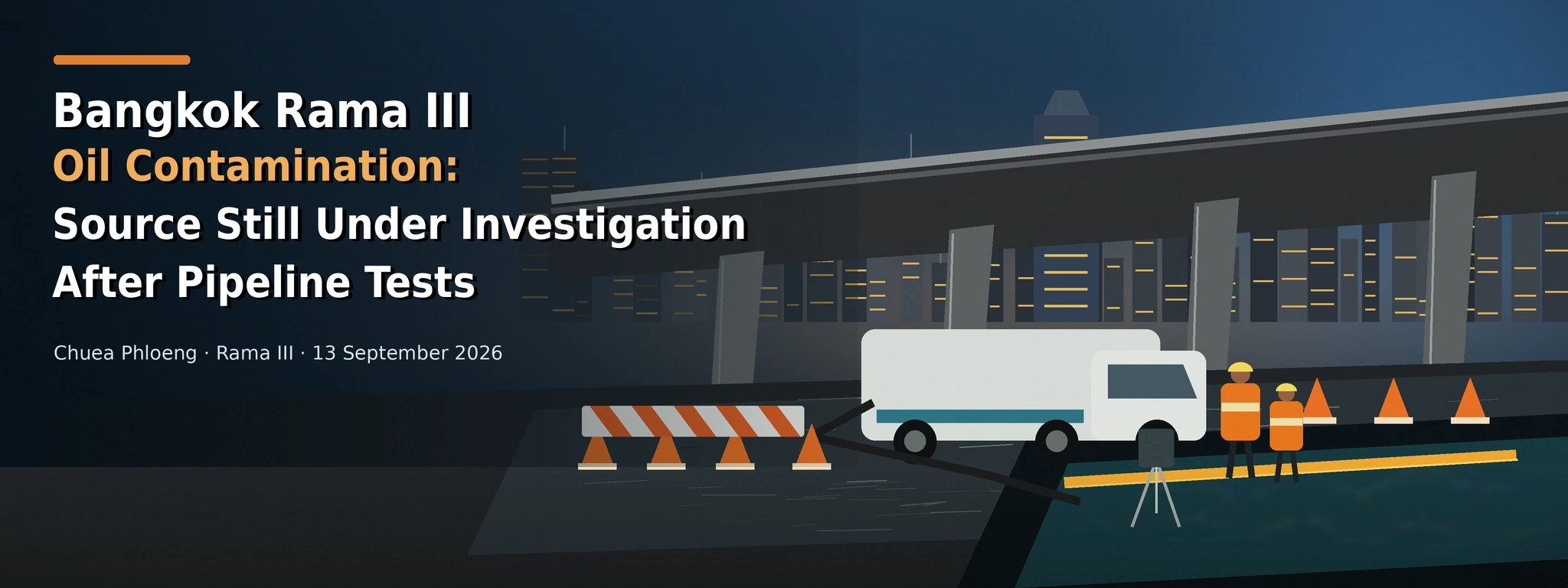
Bangkok's Rama III oil-contamination incident is contained enough for cleanup and engineering work to continue, but the source is still not conclusively established. Oil was found in drainage pipes around Chuea Phloeng Road and beneath the Rama III elevated road near Khlong Toei and Yan Nawa after residents reported a strong petroleum smell on 7 September. The latest operator update, dated 12 September, says excavation and a pressure test found no leakage from the inspected fuel pipeline, with further ultrasonic, radar and internal pipeline checks still planned.
This is the sort of Bangkok incident where the wording matters. Early reports naturally used “oil leak” as crews found petroleum contamination in city drains and excavated around an underground fuel pipeline. By 12 September, however, the pipeline operator said its pressure testing and excavations had not demonstrated leakage from that pipeline. The safest current description is therefore oil contamination with the source still being investigated.
That distinction is more than semantic. Residents need clear safety advice without being told a cause has been proven when engineers are still testing. It also prevents two opposite mistakes: dismissing the incident because one pipeline test was normal, or declaring a particular company or pipe responsible before the investigation is complete.
BFPL said it had been on site continuously since being contacted on 7 September and suspended pipeline operations on the morning of 8 September so the system could be inspected safely. A Direct Current Voltage Gradient inspection on 9 September identified three locations that warranted excavation. Those areas were opened on 10 September.
According to the operator, water mixed with oil was found at one excavated point, but the source could not be determined. That led to a pressure test on 11 September. Pipeline pressure was raised in stages from 10 barg to 28 barg, described by BFPL as normal operating pressure, and maintained for one hour while teams watched for pressure loss or seepage.
BFPL's 12 September statement says there was no abnormal pressure drop, liquid seepage or other evidence of leakage during that test. Representatives from public agencies, including the Ministry of Energy, Department of Energy Business, BMA, Khlong Toei District Office and Pollution Control Department, observed the work.
The practical takeaway is not “case closed”. It is that one suspected source has passed an important test and now requires deeper inspection before the authorities can decide what happened and whether the pipeline can resume operation.
The incident came to public attention after residents around Chuea Phloeng Road and the Rama III elevated road reported a strong petroleum-like smell on 7 September. City teams found oil contamination inside the drainage system around the Khlong Toei–Yan Nawa boundary and began containment, pumping and vapour monitoring.
Bangkok officials blocked sections of the drainage network, used oil-absorbing booms and removed contaminated liquid. By 8 September, reporting based on the Bangkok Metropolitan Administration's response said roughly 22,000 litres of residual oil or oil-contaminated liquid had been pumped out for proper treatment. The city said it would not discharge the recovered material into public waterways.
Fire and rescue teams maintained a 24-hour watch because petroleum vapours in confined drainage spaces can create a fire risk. Access around the works was controlled while crews monitored the Lower Explosive Limit, kept firefighting equipment ready and prepared the excavation site.
By 11 September, crews had been working through heavy rain and digging along the pipeline route. Some nearby residents were offered temporary accommodation because of the overnight work and the continuing controlled-area operation. The following day's BFPL statement added the important engineering update: the tested pipeline held pressure normally, so investigators still need to determine where the contamination originated.
For most Bangkok residents, this is a localised incident rather than a citywide emergency. The useful advice is specific to the affected streets and controlled work area.
Keep away from the excavation and restricted zone. Barriers and access controls are there because crews are working around petroleum contamination, underground infrastructure and heavy equipment. A shortcut through a work site is not worth it.
Avoid smoking, open flames and spark-producing activity near the affected area. Authorities have been monitoring flammable vapours precisely because vapour in drains can be more dangerous than an oily surface looks. Follow police, district and fire-service directions even if the odour seems weaker than it did earlier in the week.
Take unusual odours seriously. If residents notice a fresh strong petroleum smell, visible oily liquid in drains or another abnormal condition, use current BMA / district reporting channels rather than investigating inside a drain or utility opening. Earlier city guidance pointed residents to Traffy Fondue for abnormalities.
Vulnerable residents should be conservative. Earlier BMA-linked reporting advised extra care for children, older people and people with respiratory conditions when odours were present. If symptoms occur, move away from the affected air and seek appropriate medical assistance rather than relying on a social-media air-quality guess.
A normal pressure test is significant because a leaking pressurised pipe would ordinarily be expected to show abnormal pressure behaviour or seepage. But the operator itself is not treating the result as the final word.
BFPL says the next phase includes short-range and long-range ultrasonic testing along a one-kilometre section, radar scanning and an Intelligent Pig inspection from inside the pipe. These methods can reveal wall abnormalities or other conditions that may not be obvious from one excavation or pressure test.
The company also says its findings will be submitted to the Department of Energy Business before pipeline operations are allowed to resume. That regulatory step matters: a corporate statement about a test result is not the same thing as the authorities formally closing the incident.
For readers, the sensible standard is to separate three facts. First, petroleum contamination was found and required a major cleanup. Second, the inspected pipeline passed the 11 September pressure test according to BFPL. Third, investigators are still working to identify the contamination source. All three can be true at the same time.
The work area is around Chuea Phloeng Road beneath/near the Rama III elevated road in the Khlong Toei area, close to the Yan Nawa boundary. This is not a reason to avoid Bangkok as a whole, but anyone who lives, works or has an appointment near the immediate site should allow extra time and follow live local traffic instructions.
Excavation, safety cordons and heavy equipment can change lane access faster than a static travel article can. If a map app sends you directly towards a signed closure or controlled zone, follow the on-ground direction instead of the blue line on your screen.
Travellers using taxis between central Bangkok, the river, Sathorn, Rama III and nearby districts should be prepared for detours where the response operation affects the local road network. This is exactly the kind of incident where a 15-minute route change can matter more than a broad “Bangkok traffic” warning.
For residents immediately beside the works, the less obvious disruption may be noise and overnight activity. Reporting on 12 September said temporary accommodation had been offered to people affected by the continuing operation. Residents who need assistance should use official district / incident-response channels rather than assume the arrangement applies automatically to every address in Rama III.
Earlier BMA-linked reporting said drainage pipes were blocked to limit movement of contaminated water, oil-absorbing booms were deployed and pumped material was taken away for proper treatment. Bangkok Governor Chadchart Sittipunt said recovered material would not be released into public water sources.
The quantity often reported — about 22,000 litres — is useful for understanding the scale of the response, but it should not automatically be read as 22,000 litres of pure fuel. Reports variously describe residual oil and oil-contaminated liquid removed from the drainage system. We are keeping that distinction explicit rather than turning a cleanup volume into an unsupported estimate of how much fuel escaped from a specific source.
The environmental question is also broader than the visible oily film. Investigators need to know the petroleum type, how it entered the drainage system, whether contamination remains in inaccessible sections, and what remediation or legal responsibility follows. Until the source is confirmed, precise claims about liability or the original volume released are premature.
BFPL says it is supporting affected residents and businesses and will accept responsibility and provide appropriate compensation if the investigation confirms damage or impact resulting from its operations. That is a conditional commitment, not an admission that the company's pipeline caused the contamination.
Bangchak Corporation / BFPL — 12 September 2026 inspection update: primary operator statement on the excavation sequence, 11 September pressure test, no-leak result and planned ultrasonic, radar and Intelligent Pig inspections.
Thairath — BMA response and 22,000-litre cleanup report, 8 September: city-response details, containment, vapour monitoring, public-water protection and resident guidance.
Pattaya Mail / NNT — 12 September field update: excavation progress, restricted-site precautions and temporary accommodation context.
Verification rule: checked 13 September 2026. This remains an active technical and public-safety investigation. BMA, Khlong Toei District, the Ministry/Department of Energy Business and other competent authorities override this article if newer findings, traffic controls or safety directions are issued.