
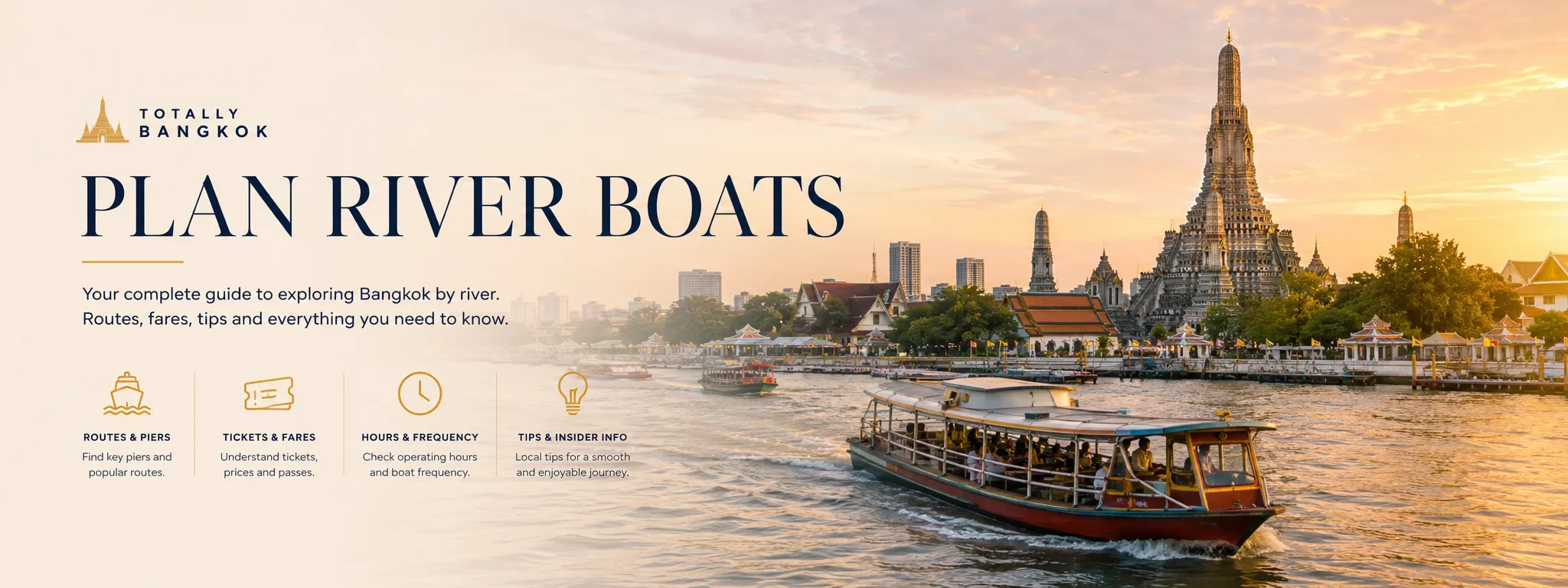
Bangkok's boats are real public transport as well as a great way to see the city. They are most useful when you understand the flag, pier and route before you step aboard.
The main river links Sathorn, the Old City, riverside hotels, Thonburi and northern districts. Chao Phraya Express Boat services use different flags and stopping patterns, so do not board solely because a boat is heading in the right direction. Check the current route board or official service information for the pier you need.
The orange-flag express service is a public route, not simply a tourist shuttle. The dedicated tourist service is generally identified separately, commonly with blue branding and a visitor-focused stopping pattern. Old guides often blur the two; look at the flag and destination board rather than relying on a remembered colour description.
River fares are inexpensive by international-city standards, but exact amounts vary by service and can be revised. The official Chao Phraya Express Boat site publishes current route and fare information; check it when an exact price matters. Keep small baht notes or coins because buying a simple single ride is easier when you are not trying to break a large note.
Sathorn Pier, also known as Central Pier, connects closely with BTS Saphan Taksin. It is a practical transfer point between the Skytrain and river services, particularly for Wat Arun, the Grand Palace area, Chinatown-side river stops and riverside hotels. Allow a little transfer time because pier queues can build at popular periods.
Several major sights are a walk or short ferry ride from river piers rather than directly beside them. Confirm the pier name for your attraction before boarding. For Wat Arun, a cross-river ferry can be more useful than staying on an express boat; for the Grand Palace and Wat Pho, choose the appropriate east-bank stop and follow local walking signs.
Short ferries shuttle between opposite banks at selected piers. They are useful for local crossings and do not necessarily follow the same ticketing or timetable as the express boats. Do not assume a day ticket for one river service covers every ferry or private shuttle.
The Saen Saep canal boat cuts east-west through parts of central Bangkok and can be dramatically quicker than a road vehicle when streets are jammed. It is a commuter service with quick boarding, narrow piers and splash screens rather than a leisurely cruise. Work out your stop before boarding and move towards the exit early.
Boarding can involve steps, gaps and a moving boat, while the ride can be noisy and wet. Travellers with limited mobility, large luggage, very young children or discomfort around unstable platforms may find BTS, MRT or a taxi easier. If you are unsure, watch one boat load before deciding whether the process suits you.
Commuter boats can be crowded at the same times as trains and roads. Keep bags compact, stand clear of boarding paths and be ready to move when your stop approaches. If sightseeing rather than commuting, travelling outside the busiest peaks gives you more time to read pier signs and a better chance of a comfortable ride.
Bangkok's wet season can bring intense downpours and changing conditions. Service interruptions or altered boarding arrangements are possible, particularly during severe weather or local events. Do not build a tight airport or intercity connection around a boat journey without a road or rail fallback.
Wait behind staff directions or barriers, let passengers disembark first and use handrails where available. Do not jump between a departing boat and the pier. Keep phones and cameras secure near the edge, and supervise children closely. Life-saving equipment is part of regulated boat operations, but good boarding behaviour is your first defence against an accident.
For a first river day, connect from BTS at Sathorn, travel north to an Old City pier, visit Wat Pho or the Grand Palace area, cross to Wat Arun if desired, then continue to another riverside district or return by boat. This gives you a useful transport experience without trying to memorise the entire network.
Bangkok's water transport is easy once you stop treating every boat as one system. Confirm three things before boarding — the service or flag, the pier you need and the final direction. That one-minute check prevents most wrong-boat mistakes and makes the river one of the city's most enjoyable ways to move around.