
Formally Wat Phra Chetuphon Wimon Mangkhalaram Rajwaramahawihan
Wat Pho is much more than Bangkok's famous reclining Buddha: it is a large working royal temple, a centre of traditional medicine and massage, and one of the easiest major sights to combine with the Grand Palace and the Chao Phraya riverfront.
The 46-metre reclining Buddha is the obvious headline, but treating Wat Pho as a single-statue attraction misses much of what makes the complex special. The temple grounds contain richly decorated chapels, courtyards, stupas and inscriptions connected with Thai history, religion, medicine and education. It is also a living Buddhist site, not a museum set: monks, worshippers, students and visitors share the same space.
For a first Bangkok trip, Wat Pho is one of the strongest Old City choices because it delivers several experiences in one visit without complicated logistics. You can see a major Buddhist image, understand temple etiquette in a real religious setting, explore quieter corners away from the busiest hall, and — if you choose — book traditional massage at the temple's medical school.
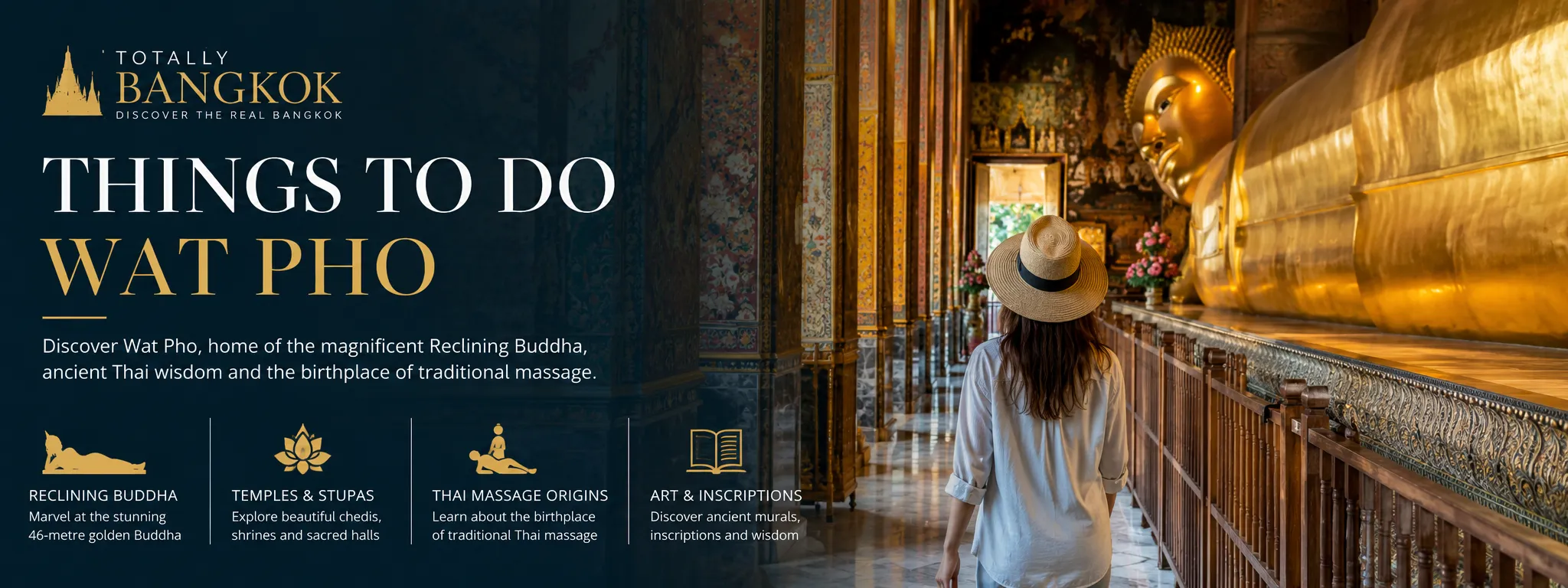
The gilded reclining Buddha fills its hall from end to end. The pose represents the Buddha entering final nirvana rather than simply resting or sleeping. The figure is approximately 46 metres long and about 15 metres high, so the experience is less about standing back for one perfect view and more about moving gradually along the narrow viewing route.
Take time at the feet. The large soles are decorated with mother-of-pearl designs associated with auspicious symbols. Crowds often bunch around the head and central viewpoints, so a slower circuit usually gives you more room to notice the details. Photography is normally possible where permitted, but the hall remains a sacred space: do not climb barriers, touch images, block worshippers or pose disrespectfully with Buddha images.
Wat Pho's official visitor information currently lists foreign admission at 300 baht per person, with free entry for children under 120 cm. There is a small inconsistency across the temple's own pages: the dedicated visit-plan page lists 08:00–19:30, while the current homepage/contact information shows 08:30–19:30. Because religious ceremonies and special events can also affect access, check the official Wat Pho visit page shortly before you go rather than building a tight itinerary around a copied timetable.
If you want the calmest conditions, morning is still the best practical strategy. Arriving near opening usually means lower heat and fewer organised groups. Late afternoon can be atmospheric, but do not leave the reclining Buddha until the final minutes of the day and assume every internal area will remain accessible until the outer gate closes.
Allow roughly 60–90 minutes for a relaxed first visit without massage. A very focused visit to the reclining Buddha and main courtyards can be shorter, while visitors interested in architecture, inscriptions and photography can comfortably spend two hours. Add substantial extra time if you plan a massage because waiting and treatment time are separate from temple sightseeing.
Wat Pho works best when you resist the temptation to race directly from the entrance to the reclining Buddha and back out. After the main hall, walk through the quieter compounds and courtyards; the contrast between the famous image and the rest of the complex is part of the experience.
The official temple asks visitors to dress politely. Women should not wear shorts above the knee, and all visitors should avoid clothing that is obviously inappropriate for a working religious complex. Carrying a light overshirt or scarf is useful if your Bangkok day also includes malls, river transport or other places with different dress expectations.
Shoes must be removed before entering certain religious buildings; use the designated racks or bags where provided. Keep voices low inside chapels, do not point your feet at Buddha images, and give worshippers room. Wat Pho's visitor guidance also reminds women not to make physical contact with monks or novices. These are not tourist-theatre rules — they reflect the temple's religious function.
Wat Pho is closely associated with Thai traditional medicine and massage, and the temple's traditional medical school operates massage services within the complex. This is a practical service rather than a spa-style luxury experience: expect a functional treatment setting focused on traditional technique.
As of August 2026, Wat Pho's official visit page lists Thai massage and foot massage at 340 baht for 30 minutes and 520 baht for 60 minutes, with longer and balm/oil options also available. Prices and queues can change, so check the official page rather than treating those figures as permanent. If massage is important to you, ask about the current wait early in your visit and structure your sightseeing around the available slot.
Sanam Chai MRT station on the Blue Line is the simplest rail option for many visitors. From the station, Wat Pho is a short walk through the Old City area. The station also makes Wat Pho much easier to visit independently than older guidebooks suggest; you do not need to rely on a taxi or tuk-tuk simply because the temple is outside the BTS network.
Use the official Bangkok MRT/BEM information for current service notices. If you are travelling in peak heat, factor the walk into your day and carry water rather than arriving already overheated.
The Chao Phraya is the most enjoyable approach if you are already near a river pier. Tha Tien is the traditional river access point for Wat Pho and the cross-river connection toward Wat Arun. Boat services and stopping patterns can change by flag, time and day, so check the Chao Phraya Express Boat current route information instead of memorising an old pier timetable.
River travel is especially useful when combining Wat Pho with Wat Arun, while MRT is usually simpler if your hotel is near the Blue Line. The best transport mode is therefore determined by the rest of your day, not by a single universally "best" route.
Wat Pho sits immediately south of the Grand Palace precinct, making the two sights an obvious pair. For most visitors, the best sequence is to tackle the Grand Palace first near opening, then walk to Wat Pho. The Grand Palace has stricter security, heavier crowds and more potential for schedule changes, while Wat Pho generally works better as the more flexible second stop.
Do not underestimate heat. Even though the distance is short, both complexes involve outdoor walking, shoes on and off, queues and limited shade in places. A lunch or drink break between them can make the second half of the morning far more enjoyable.
Wat Pho and Wat Arun form one of Bangkok's best temple combinations because they sit on opposite sides of the river and feel very different. Wat Pho is sprawling, low-rise and interior-focused; Wat Arun is dominated by its riverside prang and exterior ceramics.
A practical sequence is Grand Palace → Wat Pho → river crossing/boat connection → Wat Arun, provided you are comfortable with a full sightseeing day. If temples are only one part of your interests, skip the urge to "collect" every nearby site and instead choose two with enough time to notice the details.
Morning gives you the best chance of moving through the complex before peak heat and large tour groups. The reclining Buddha hall can be difficult to photograph cleanly because of its scale and narrow viewing space, so wide-angle phone lenses help, but avoid blocking the flow while composing shots.
For exterior courtyards and chedis, changing light throughout the day can be more interesting than a single famous angle. Wat Pho is not a place where one Instagram frame tells the whole story; the texture, colour and architectural details reward a slower walk.
Wat Pho is a historic religious complex, so surfaces, steps, thresholds and shoe-removal areas can make it less straightforward than a modern attraction. Visitors who use wheelchairs or have limited mobility should expect that not every internal space will be equally accessible. The broad grounds themselves can also be tiring in Bangkok heat.
If mobility is a concern, prioritise the reclining Buddha and the main courtyards rather than trying to cover every corner. Contact Wat Pho directly before visiting if you need a specific access arrangement; the official site lists current temple contact details. Sanam Chai MRT provides a useful step-free public-transport approach, but the final temple experience still involves a heritage environment.
Wat Pho can work well for children because the reclining Buddha has immediate visual impact and the site can be visited in a relatively compact block of time. The official visitor page currently says children under 120 cm enter free. The bigger family challenge is usually heat, temple etiquette and keeping young children patient during shoe removal and crowded indoor sections.
For families, a shorter high-quality visit is better than stretching Wat Pho into a two-hour architectural survey. Explain before entering that it is an active temple, not a playground, and build in a food or river break afterwards.
One of Bangkok's oldest tourist scams is the unsolicited claim that a major attraction is "closed today", followed by an offer to take you somewhere else. Do not accept closure information from a random driver or street approach. Check the temple's official website, entrance staff or a reliable current source.
Other common mistakes are arriving in unsuitable clothing, assuming massage has no queue, treating the 300-baht fee as permanently fixed, or trying to visit Grand Palace, Wat Pho, Wat Arun, Chinatown and several museums in one rushed day. Bangkok's Old City looks compact on a map, but heat and crowd friction make aggressive schedules exhausting.
Step 1: arrive in the morning via Sanam Chai MRT or river transport. Step 2: confirm current admission, opening conditions and any internal closures at the entrance. Step 3: see the reclining Buddha before the hall becomes crowded. Step 4: spend time in the courtyards and main temple areas rather than leaving immediately. Step 5: check massage availability if that is part of your plan. Step 6: continue to the Grand Palace or Wat Arun depending on your route and energy.
This approach leaves enough flexibility for weather, queues and religious activity while still covering the reason most travellers came. Wat Pho is at its best when it feels like a real place rather than a box to tick between photo stops.
For volatile details such as opening time, admission and massage rates, use Wat Pho's own visitor information first. As of this update, the official visit page lists 300-baht foreign admission and the massage service timetable/rates, while the temple homepage/contact pages show a slightly later opening time than the dedicated visit page. That discrepancy is exactly why checking the live source matters.