
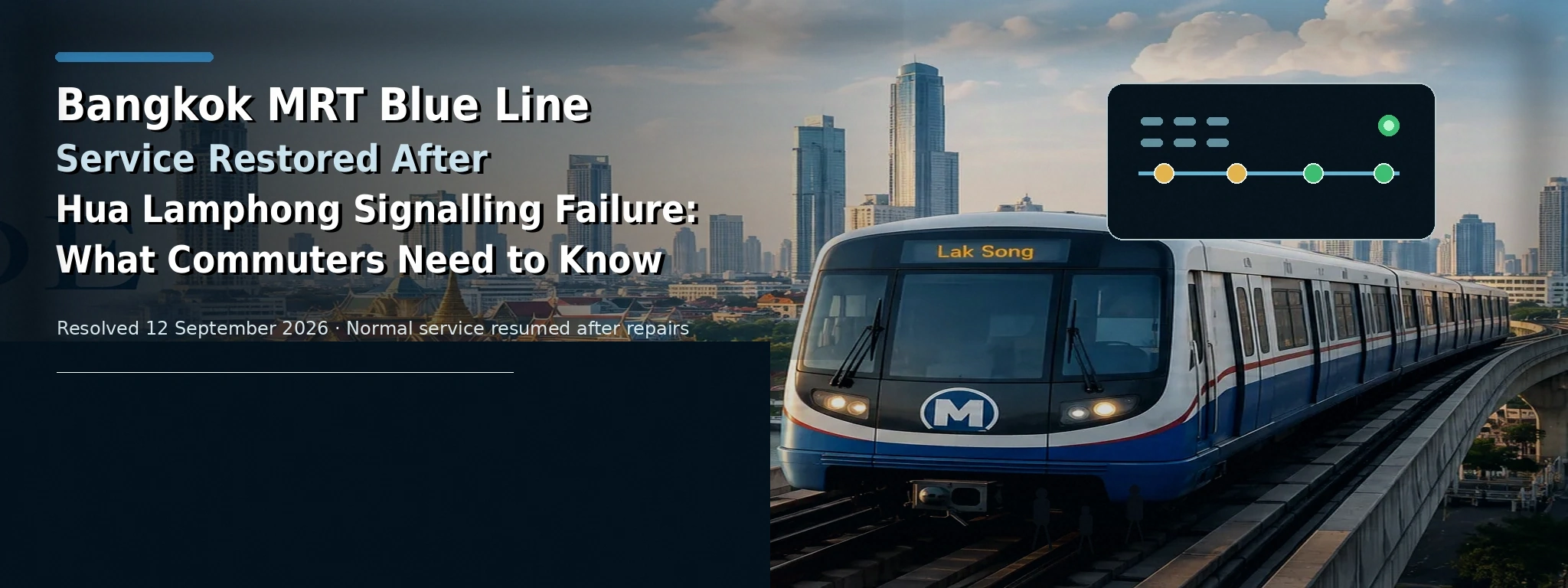
Bangkok’s MRT Blue Line is back in normal operation after a signalling-system failure at Hua Lamphong disrupted a large section of the network on Saturday 12 September. BEM’s first operator update put the fault at 13:20, with trains between Itsaraphap and Phetchaburi initially delayed by as much as about 30 minutes. The disruption later became more serious, with a section of the line suspended and passengers redirected to backup rail and bus options. Repairs were reported complete and normal service began returning at about 16:13.
For Bangkok commuters, the useful part of yesterday’s disruption is not just that a fault happened. It is the way a problem at one central station can ripple across a circular line and force temporary changes well beyond the point where the equipment failed. The Blue Line links residential districts, offices, shopping areas, Bangkok’s Old City fringe and major interchange points, so even a few hours of disruption can affect a large number of ordinary journeys.
The second useful lesson is that “30-minute delay” can be only the first stage of an incident. BEM’s early public notice warned of delays between Itsaraphap and Phetchaburi; as work continued, authorities moved to a more substantial contingency plan, including split services, alternative rail connections and shuttle buses. If you see an operator alert while you are already travelling, keep checking it rather than assuming the first estimate will remain the final one.
BEM’s operator feed reported a signalling-system failure at Hua Lamphong Station at about 13:20 on Saturday 12 September 2026. The fault affected Blue Line services heading towards Tha Phra and Lak Song. The first public update said passengers between Itsaraphap and Phetchaburi could experience delays of up to about 30 minutes and should allow extra travel time.
A signalling fault is operationally different from a simple late train. Railway signalling helps control train movements and safe separation. When a signalling system cannot be relied upon, the operator may have to reduce, reorganise or suspend train movements in the affected area while technicians isolate and repair the problem. That is why a fault at one station can produce a much wider service impact.
By BEM’s 14:25 follow-up, the operator was still working to resolve the issue and continued to warn that services towards Tha Phra and Lak Song were disrupted. Later reports from the disruption period show that the affected section had moved beyond ordinary delay management and into partial suspension/backup operation.
The core disruption was reported between Phetchaburi and Itsaraphap. Contemporary reporting described this as a 12-station section of the Blue Line. That includes a strategically important run through central Bangkok and helps explain why passengers at stations outside Hua Lamphong itself also encountered closures, forced exits or advice to use another mode.
The direction named in BEM’s public alerts was towards Tha Phra and Lak Song. In practical terms, the incident mattered to more than people whose destination was Hua Lamphong: anyone relying on a through journey across the affected section could suddenly find that the normal one-seat trip was no longer available.
Reports during the outage also showed passengers being redirected towards other network connections. That is a reminder that Bangkok’s rail map works best as a network rather than a set of isolated lines. A Blue Line disruption can make BTS, Airport Rail Link, buses, taxis or ride-hailing the better choice for part of a trip even when the final destination remains close to an MRT station.
During the fault, BEM and MRTA moved to contingency arrangements rather than simply telling passengers to wait indefinitely. Reporting from the period described a split-service/backup operating plan, while the Bangkok Mass Transit Authority provided shuttle-bus support between Rama 9 and Tha Phra. Passengers were also advised to consider BTS connections where those gave a workable route around the affected section.
That response matters because the Blue Line is not easily replaced by one single alternative. A commuter travelling from the northern side of the line, somebody heading into Sukhumvit, and a visitor trying to reach the Old City or a railway connection may all need different workarounds. The right fallback depends on where you are standing when the disruption occurs.
If another major outage happens, look first for the operator’s specific interchange advice. During yesterday’s incident, reported guidance included BTS transfer options and Airport Rail Link access via the wider rail network. Do not copy a workaround from an old incident without checking whether the affected section and direction are the same.
Current reporting says BEM announced at about 16:13 on 12 September that repairs to the signalling system had been completed and that normal operations were gradually resuming. That puts the main incident window at a little under three hours from the first 13:20 alert, although individual passengers may have experienced shorter or longer disruption depending on their station, direction and the point at which they encountered the problem.
“Service restored” can also be different from “every train instantly back on timetable”. When a rail line resumes after a significant interruption, trains and passenger loads may need time to rebalance. If an operator says services are resuming progressively, it is sensible to allow extra time even after the technical fault itself has been fixed.
For Sunday 13 September, the sources reviewed for this article do not show yesterday’s signalling failure continuing as an active Blue Line disruption. Anyone travelling should still check live BEM information because a new incident, maintenance issue or unrelated delay can obviously arise after publication.
If the MRT is part of your daily commute, this incident is a good reason to know your second-best route before you need it. That does not mean memorising the entire Bangkok transport map. It means knowing which BTS station, bus corridor or road-based option can get you across the same part of the city when your normal Blue Line section is unavailable.
For work, appointments or school pickups, treat an active operator disruption notice as a reason to add margin immediately. Waiting twenty minutes to see whether the problem disappears can be the right choice for a flexible trip, but it can also turn a manageable delay into a missed appointment if the incident escalates from slow running to a partial suspension.
It also helps to separate the technical incident from the crowding that follows it. Once trains are reduced or stopped, queues build at ticket gates, interchange stations and road pickup points. Even after service resumes, the first trains may be crowded. A nearby bus or BTS route can still be faster than joining the first wave back onto the MRT.
For visitors, the biggest mistake is assuming that a station closure means the whole Bangkok rail network is unusable. Yesterday’s fault was on the MRT Blue Line, not a citywide shutdown. BTS and other services remained potential alternatives, and authorities specifically directed passengers towards other connections during the disruption.
If you are heading for a time-critical flight, long-distance train, event or booked tour, do not wait for perfect certainty. Check the operator alert, open your live map, and compare an alternative route. A taxi or ride-hail may help, but road traffic can become heavier when a major rail corridor is disrupted, so “just get a car” is not automatically the fastest answer.
If you are sightseeing and the trip is flexible, changing the order of the day can be smarter than crossing town through the affected area. Bangkok has enough dense districts that you can often move lunch, shopping, a museum or another nearby stop forward while the transport problem is being resolved.
Start with BEM. BEM operates the Blue Line and publishes operational alerts through its MRT channels. Its official MRT website also carries network information and links to the Bangkok MRT app. For an active incident, the operator’s latest time-stamped update should beat an old news story or a screenshot being recirculated in a chat group.
Check MRTA and traffic channels when the disruption is large. Major incidents can trigger system-wide advice, bus support or interchange recommendations. Bangkok traffic radio and official agency channels can be useful for the road side of the problem.
Check your exact journey, not just “is MRT running?” Yesterday’s Blue Line issue affected a particular section and direction, while other parts of the network were able to operate under altered arrangements. A useful live check is origin + destination + interchange, not a single citywide yes/no question.
Re-check after restoration. If BEM says the fault is fixed, look for whether service is “normal”, “resuming”, or still subject to residual delay. Those words matter when you have a tight connection.
BEM MRT official operator feed: incident notices on 12 September reporting the Hua Lamphong signalling failure, the affected directions and the initial delay between Itsaraphap and Phetchaburi.
BEM — official MRT website: current operator information for the Blue Line, route planning and official MRT service channels.
Kaohoon — 12 September disruption report: contemporaneous Thai reporting based on MRTA/BEM information, including the backup transport arrangements and BMTA shuttle support.
Bangkok Report — service restoration report: reports BEM’s 16:13 repair completion/restoration update and the scale of the affected Phetchaburi–Itsaraphap section.
Verification rule: incident facts were checked against BEM’s operator updates and multiple same-day reports on 13 September 2026. This article describes a resolved 12 September incident. Live service conditions can change at any time, so use BEM’s current channels before changing a journey today.