
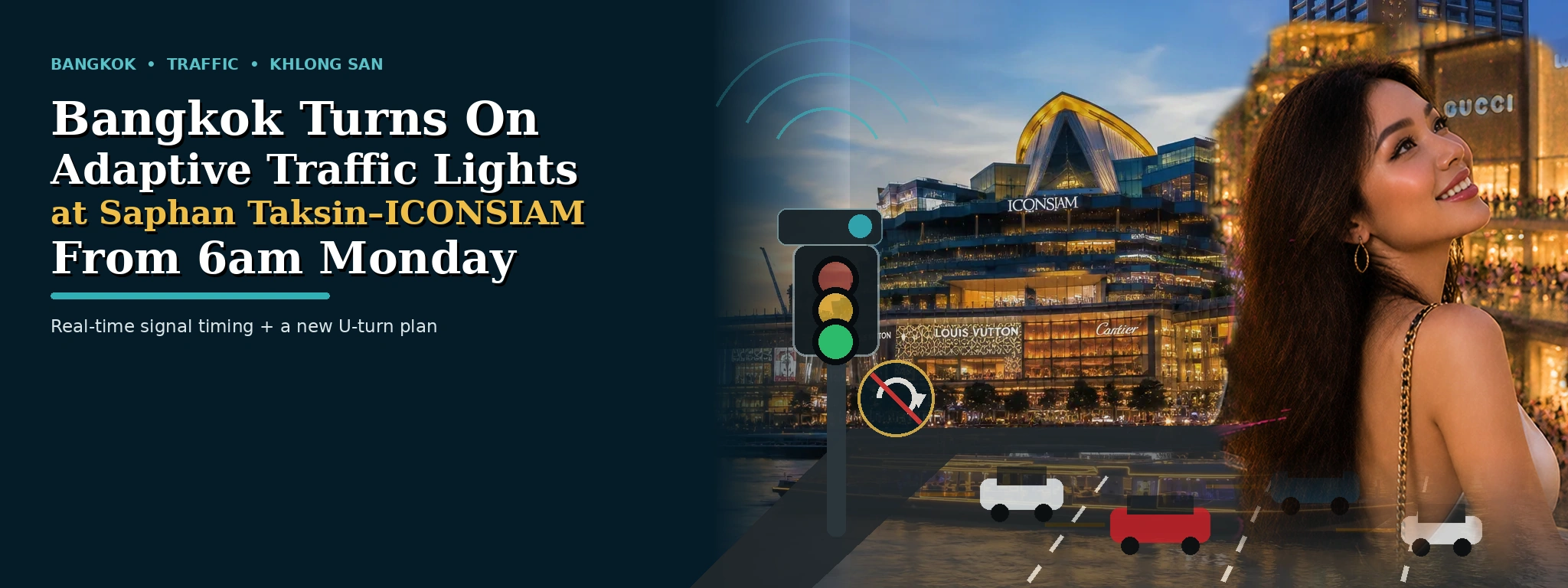
Bangkok is switching on an Adaptive Control traffic-signal system around Saphan Taksin and ICONSIAM from 06:00 on Monday 14 September 2026. The Bangkok Metropolitan Administration says the signals will use real-time camera data to adjust green and red phases to current traffic volumes, while a revised road layout will stop U-turns directly in front of ICONSIAM for vehicles heading toward Saphan Taksin.
The practical importance of this change is timing. It begins just as Bangkok heads into a normal Monday morning travel period, and it affects one of the riverfront area's busiest road interfaces: Charoen Nakhon, access to ICONSIAM, the approach to Saphan Taksin and the wider connection toward Sathorn. Even drivers who are not going to the shopping centre can be affected by queues that build when turning vehicles, through traffic and pedestrian movements compete for the same road space.
The new system is intended to manage that pressure as a network. Instead of treating each set of signals as an isolated junction with a fixed green time, BMA says the system will use current traffic-volume information from cameras and adjust signal phases to what is actually happening on the road. The road-layout change is equally important: a U-turn movement that can cut across traffic in front of ICONSIAM is being removed for the direction heading toward Saphan Taksin.
BMA says the Adaptive Control system will begin operating in the Saphan Taksin–ICONSIAM area at 06:00 on Monday 14 September 2026. The start was announced after Governor Chadchart Sittipunt and Bangkok officials inspected traffic management in the area on Sunday 13 September.
There are two connected changes. First, the signal system will draw on real-time traffic-volume data from cameras and vary the timing of green and red lights according to traffic in different directions. Second, the road arrangement directly in front of ICONSIAM is being reorganised, including a change to where some vehicles can make a U-turn.
These are not the same thing as a road closure. The reports reviewed by Totally Bangkok describe a change in traffic management and lane movements, not a closure of Saphan Taksin, Charoen Nakhon Road or ICONSIAM. However, the first morning of a new traffic pattern can still produce unfamiliar lane choices and short-term queuing as drivers adapt, so road users should not assume their normal approach will feel exactly the same.
Traditional fixed-time signals use pre-set phases that may work well when traffic volumes broadly match the assumptions used in the signal plan. The problem is that Bangkok traffic can change quickly. A queue may build in one direction while another approach has less demand, or a heavy wave of vehicles can arrive after a bridge release, a shopping-centre exit or another upstream junction changes.
According to the BMA explanation reported on Sunday, Adaptive Control uses information from cameras measuring traffic volume in real time. The system can then adjust the timing and duration of traffic signals to better match the observed flow in each direction. The stated aim is to reduce unnecessary waiting and help clear accumulating queues.
Governor Chadchart also stressed a network approach. Changing one intersection in isolation can simply move a queue to the next junction. The intention is therefore for signals across the area to work in relation to one another, responding to conditions across the local network rather than maximising flow through one set of lights at the expense of the next bottleneck.
That distinction matters for expectations. Adaptive signals are a traffic-management tool, not a promise that congestion disappears. Their performance depends on the volume entering the network, turning demand, pedestrian crossings, incidents and other real-world conditions. Monday's operation will provide the first useful test of how the new settings behave during a working-day traffic pattern.
The lane plan reported for the ICONSIAM frontage differs by direction. For vehicles heading toward Wongwian Yai, there are three traffic lanes. The left lane is to continue straight; the middle lane can continue straight or turn right into ICONSIAM; and the right lane can be used for a U-turn or to enter ICONSIAM.
For the three lanes heading toward Saphan Taksin, the significant change is the removal of the U-turn directly in front of ICONSIAM. Drivers who need to reverse direction are instead being directed to the U-turn area around the Charoen Nakhon Soi 10 intersection. The stated purpose is to reduce conflicting movements and vehicle accumulation in front of the mall.
Drivers should follow the actual signs, markings and traffic officers on the day rather than relying only on a remembered lane position from a previous trip. If you normally make the old U-turn, build the alternative into your route before entering the busiest part of Charoen Nakhon rather than trying to change lanes at the last moment.
The location combines several different traffic demands in a relatively constrained urban space. Charoen Nakhon carries through traffic; Saphan Taksin connects the Thonburi side with Sathorn and central Bangkok; ICONSIAM generates substantial vehicle movements into and out of its entrances; and the riverfront district has heavy pedestrian activity.
BMA's Sunday inspection specifically highlighted the importance of coordinating the Charoen Nakhon, Saphan Taksin and Sathorn connections. A change that clears one approach too aggressively can send a large group of vehicles into the next constrained section before it is ready to receive them. That is why the city is describing the adaptive system as network management rather than simply a faster traffic light.
Pedestrian safety is also part of the equation. People cross in front of the mall and around the transport links, so traffic cannot be managed purely by maximising vehicle throughput. BMA has told turning drivers to slow down, watch for people crossing and comply with signals and officers. For a visitor unfamiliar with the road layout, that is especially important: do not treat a green vehicle phase as permission to rush a turn without checking the crossing environment.
If your journey can avoid the area during a busy period, BMA has encouraged people without a need to use Saphan Taksin to consider an alternative route when traffic is heavy. If you do need to drive through Khlong San or approach ICONSIAM, allow extra time on Monday morning and check live conditions before committing to the bridge or Charoen Nakhon.
The most useful preparation is route-specific. If your usual trip includes the U-turn in front of ICONSIAM while heading toward Saphan Taksin, plan for the Charoen Nakhon Soi 10 alternative. If you are being picked up by a taxi or app-based car, make sure the driver has the correct entrance or side of the road; a casual request to "U-turn at the mall" may no longer match the permitted movement.
For hotel transfers, airport runs, appointments and other time-critical trips, the first morning of a new traffic operation is a sensible time to add margin. There is no verified basis yet for claiming a specific number of minutes saved or lost. Live conditions will be more useful than a generic prediction.
BMA Traffic provides current road information and CCTV images. Checking those feeds shortly before departure can help you decide whether to stay with the bridge route or use an alternative. Once you are in the controlled area, follow temporary directions from officers even if your navigation app suggests a movement that is no longer permitted.
The reports reviewed for this story describe a road-signal and traffic-layout change. They do not announce a BTS Silom Line or Gold Line service change connected with the Adaptive Control launch. People arriving by rail should therefore distinguish the new road arrangement from the operation of the rail network itself and check the relevant operator separately if they need live train status.
For pedestrians around ICONSIAM, the city has emphasised crossing safety because turning vehicles and people on foot share a busy frontage. Use designated crossings, obey signals and be alert to drivers adjusting to the new lane pattern. The first day may be unfamiliar not only for motorists but also for passengers getting in and out of taxis or rideshares near the shopping centre.
Visitors who do not need a car may find rail and river connections useful alternatives when roads are heavily congested, but the best option depends on the origin and destination. Totally Bangkok's getting-around guides explain the BTS, river boats and local connections; live operator information should still take priority on the day of travel.
The launch is a real operational change, but the outcome should be judged after it has run in actual traffic. The sources available on Sunday explain how the system is intended to work; they do not provide Monday performance results because those results do not exist yet.
Useful indicators will include whether queues clear more evenly across connected junctions, whether the removed U-turn reduces conflicting movements in front of ICONSIAM, and whether drivers adapt smoothly to the revised layout. BMA officials can also change operating decisions as they observe conditions, so anyone who uses the area daily should pay attention to later city or traffic-police updates rather than assuming the first configuration will never be adjusted.
Totally Bangkok will treat claims about travel-time improvement cautiously. A quieter off-peak period and a Monday peak are different tests. Weather, incidents, construction and unusually high demand can also affect the result. The practical takeaway for 14 September is simple: know the U-turn change, expect dynamic signal timing, check live traffic and allow some flexibility while the new arrangement beds in.
FM91 Trafficpro — 13 September 2026: same-day report from Governor Chadchart Sittipunt's inspection, including the 06:00 start, real-time camera-based signal control, lane arrangement, U-turn relocation, pedestrian-safety emphasis and BMA Traffic advice.
Thansettakij — 13 September 2026: detailed report of the BMA traffic plan, the network-management approach, lane assignments and the move of Saphan Taksin-bound U-turn traffic to the Charoen Nakhon Soi 10 intersection.
Bangkok Biz News — 13 September 2026: corroborating report on the Adaptive Control launch and revised traffic plan around ICONSIAM.
BMA Traffic: Bangkok's live traffic/CCTV service referenced in the reporting for checking current road conditions.
Verification rule: the start time, traffic-system description and lane changes were cross-checked across multiple reports published on 13 September. No specific travel-time saving has been stated as fact, and this article does not treat Monday's results as known in advance.